Saat Phere: The 7 Vows and the Rituals Of Hindu Marriage

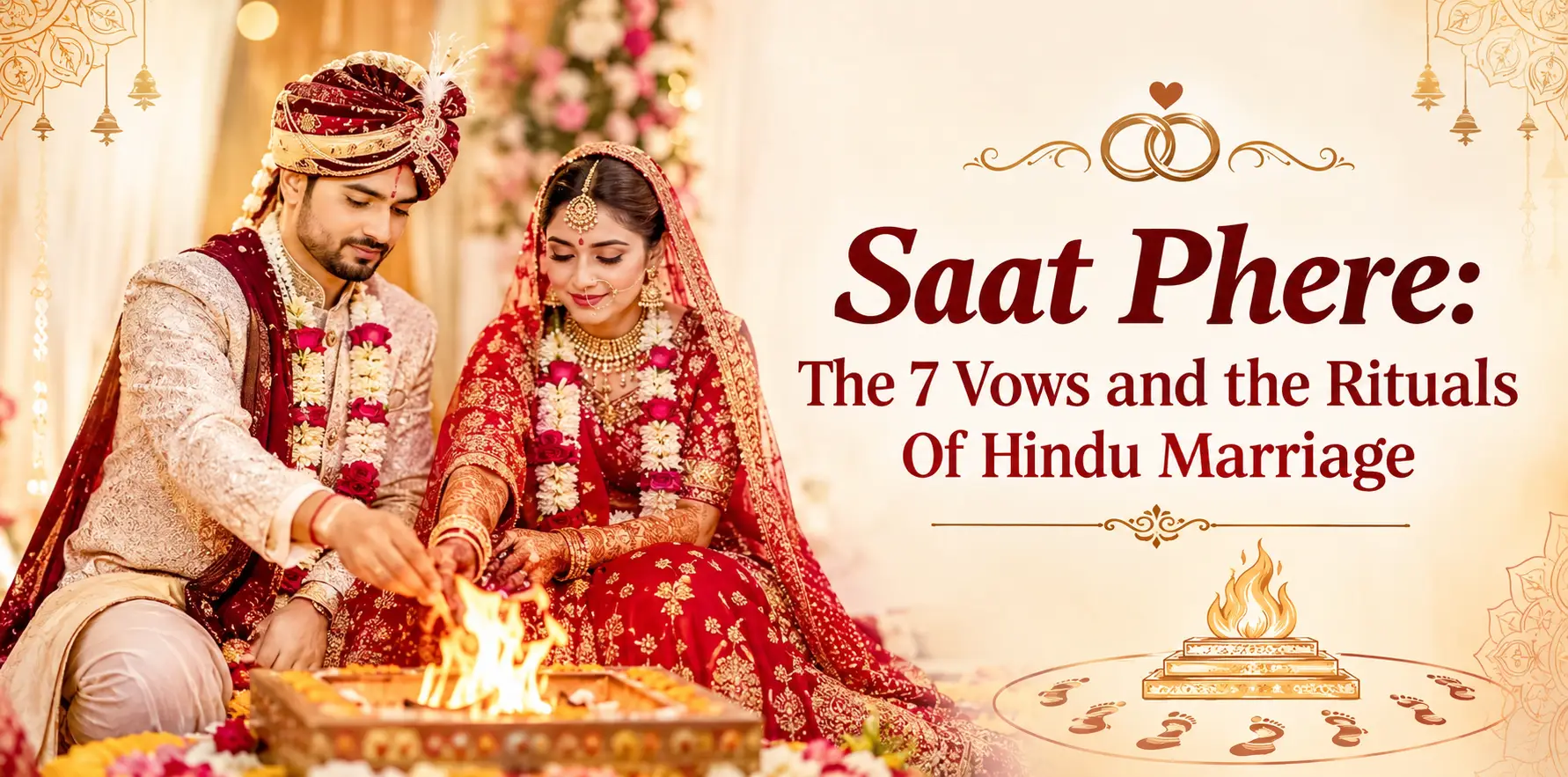
A Hindu wedding is a vibrant celebration with bright colors, music, and unique rituals. However, there is one sacred and significant ritual in a Hindu wedding called Saptapadi. It is a ceremony where a bride and groom take seven steps together around the sacred fire while making vows to each other.
If you are going to attend a Saptapadi or if you are just curious about the seven steps of marriage, this guide will help you understand the beautiful traditions behind this ritual. We have explained all the details in a very simple and easy-to-understand language for kids and grandmas.

What does Saptapadi mean?
Saptapadi means seven steps in Sanskrit. Sapta means ‘seven’ and padi means ‘step’. It refers to the seven steps a couple goes through together during a wedding. In the presence of Agni, the Holy Fire, as witnesses to the seven marriage vows that symbolize these steps.
How is Saptapadi performed?
Well, actually quite romantic! You hold hands or tie your clothes as you roam around the sacred fire, Agni. Agni is the Vedic god of fire who witnesses all couples’ promises. The presence of fire is thought to represent the sun, the almighty source of energy, and the digestive fire within us, the source of life. Majorly performed by the people of Hindu community, Saptapadi can be seen in Punjab, Bihar, Uttar Pradesh, West Bengal, Orissa, Tamil Nadu, Kerala and all the other regions where Hinduism is followed. Although Saptapadi is addressed by different terms in different regions, the vows and ritual methods remain almost the same. The importance of fire or Agni and the recital of vows under a star-studded night sky are two prominent factors in every Saptapadi ceremony.
What Are the 7 Vows of Hindu Marriage
When I thought about vows, the first thing that came to my mind was the personalized, bespoke wedding vows you see in the movies. Hindu marriage vows are a little different in that there are no separate vows written by the couple. Nonetheless, as you go through that process, you feel a tingling excitement as you figure out what the tried-and-true tradition means. After all, these vows have been kept, repeated, and kept throughout the ages. See if your ideas and dreams are included in her 7 Marriage Vows
The First Vow: A Vow of Duty
They promise to give each other good things in life. Food, physical and mental nourishment, and abundance. So all your basic needs are met.
The Second Vow: A Promise of Strength
They promise to take care of each other and pray for each other’s physical and mental health and strength. So there is always someone to take care of you.
The Third Vow: A Commitment to Prosperity
In this vow, you promise to develop a love for each other. Doing so will make you feel valued and loved and make you a better person.
The Fourth Vow: A Pledge of Love and Respect
They vow to be lifelong companions. So in good times and bad, you are not alone.
The Fifth Vow: A Prayer for Progeny
I pray that we will grow together in thinking and acting. Find common ground among differing opinions.
The Sixth Vow: A Request for Health and Peace
You care about your children, your family, and your community, and pledge to work together to ensure their prosperity. Therefore, if there is a union, everyone benefits.
The Seventh Vow: A Swear of Friendship and Loyalty
Finally, you pledge to develop a noble spirit and live a sacred and spiritual life in your community. Both agree to follow a philosophical and spiritual path in life.
So we can see that the Saptapadi Vow, or the Seven Vows of Hindu Marriage recognizes and accommodates the expectations and ambitions of all couples. They are designed so that every dream you have had, has, or will have in the vows is included in the vows. Pursue wealth, success, fame, spirituality, and be a parent or philanthropist. These timeless vows have it all. Grow with your special someone and acknowledge their right to spread their wings in all directions.
Legend of Saptapadi
There is a beautiful story behind the tradition of Saptapadi Vows and its beginnings. The story of Servisree and Sativan. When her beloved husband Satiwan dies young, his devoted wife Savisree follows the shinigami Yama who carries away her soul. Yama, realizing that her girlfriend is following him, tells her to turn back. She replies that she has become his girlfriend because she has already walked more than seven steps with him. She strikes up a conversation with him as his girlfriend. She conquers the lord of death with her wit and intelligence and forces her husband to regain her life. That’s why her seven steps in starting a friendship or relationship are so important.
How is the ceremony performed?
Details on performing saptapadi may vary from region to region, but the order of steps to perform saptapadi is pretty much the same everywhere. The most important and final step in performing this ritual is to determine the most convenient schedule for performing Saptapadi on the eve of the wedding. This is done by the priest considering the kundur of the bride and groom. When a schedule is set to perform this vidi, the whole family gathers around the Agni (fire), and the couple and their parents sit closest to the Agni with the priest. The groom holds the bride’s little finger and makes her first four vows, after which the bride completes her remaining three rounds. Flowers and rice showers are showered by families seated around the mandap while the couple performs saptapadi. As a token of my blessing to them. The Saptapadi ceremony concludes with the chanting of Shloka asking for the blessings of Lord Vishnu, the protector of the world and the goddess of wealth, Lakshmi. These Shlokas conclude the Saptapadi ceremony, marking that the couples have sworn to be together for seven lifetimes and are now officially and legally married.
The Role of 7 pheras in hindu marriage
There are several reasons why the 7 pheras or steps, are so significant in a Hindu wedding. Let’s have a look at the five most important reasons.
- Legal and Sacred Significance: Completing 7 pheras is an important part of many Hindu wedding traditions, but it is not universally required for a marriage to be legally valid.
- Equality: Marriage is an equal union of two people. Walking together around the fire signifies partnership and togetherness.
- Bringing Two Families Together: A marriage unites two families. Walking around the fire brings elders from both families together.
- Soulmates for Seven Lifetimes: It is believed that during these seven steps, the souls of a bride and groom become one. Hence, they spend seven lifetimes together after death.
Things to Remember During Saath Phere
- If you are going to perform or attend this sacred ritual anytime soon, here are a few quick tips for you.
- Wear comfortable clothes. Even though you look good in your wedding outfit, try to avoid wearing clothes that may make it hard to walk. Also, make sure that your knot or gathbandhan does not come undone while taking steps together. Listen to what the priest is saying, and think about your vows.
- The fire can be hot, so be mindful not to get too close to the Havan Kund and its surrounding area. Remember to smile and relax as you take each step. After all, this is a joyous occasion for you and your partner.
Conclusion
Saptapadi, or seven steps, is a beautiful and special ritual. It helps a couple to build a strong bond based on love and friendship. Walking around the sacred fire symbolises the couple’s commitment to a lifelong partnership with the blessings of the divine.
FAQ’s of Hindu Seven Vows of Marriage
Is Saat Phere compulsory in every Hindu marriage?
No, Saat Phere is not compulsory in every Hindu marriage. Hindu wedding rituals vary across communities and regions. The seven steps are the most essential part of the Indian wedding traditions.
Why do couples walk around the sacred fire during Saat Phere?
Fire is pure and bright. It is God’s ultimate truth and light, according to ancient Indian beliefs. Hence, taking vows around the fire signifies seeking God’s blessings.
What is the difference between 4 Pheras and 7 Pheras?
Pheras play a very important role in Indian wedding ceremonies. 7 phera are 7 promises that the bride and groom make to each other forever. These phera hold the newlyweds in a sacred bond that binds them together as husband and wife in all situations of life. Every Hindu wedding has at least 4 phera and these phera have special meaning and are related to 4 Purushartha or great wisdom pearls of life: Dharma, Artha, Kama and Moksha.
Who leads during the Saat Phere ritual?
Mostly, the groom takes the lead during the first few steps. He does this because he is supposed to be the breadwinner and protector of his wife and children. After some steps, the bride takes the lead to signify that she manages the family and home.
Do different states in India have different Saat Phere traditions?
Yes, Hindu wedding rituals vary across different parts of the country. Some people take four rounds around the fire and seven steps on a heap of rice, while others take seven rounds around the fire.
admin
Table of Contents
You might also like: